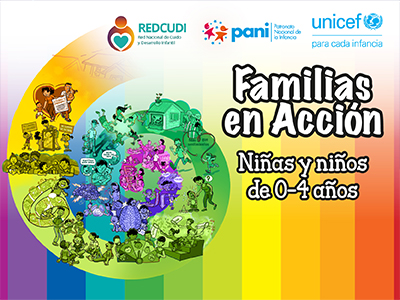

Cover image: © UNICEF/UN
Families in Action (FAMA) is a space, a virtual route to reflect, learn and grow about parenting and interaction with children in our homes. This series offers a virtual course with twelve sessions that contain information and Learning exercises seek to: Strengthen mothers, fathers and people caregivers with parenting patterns based on respect and commitment to the rights and integral development of children between the ages of 0 to 4 years.
This virtual course will allow parents, and caregivers learn and apply the patterns of rights-based parenting and seeking the integral development of Girls and boys aged 0 to 4 years organized into 12 sessions:
Each session is an entertaining process for you to learn to protect the rights and promote the duties of children from the earliest by promoting their experience and enjoyment, as well as by preventing or avoid its denial or violation. In each one you will find for each pattern Breeding:
- Valuable, meaningful, and useful information.
- Interactive resources and exercises for the Learning from everyday experience
The contents and pedagogical exercises seek to Promote that you learn from your experience and daily life a form of upbringing with a focus on rights and integral development that prevent and avoid violence and assume compliance in family life responsible for the upbringing and integral development of children and adolescents.
The course can be taken individually or with small groups that meet to develop or share the activities proposals with their own products.
For 12 sessions you can share, talk, exchange ideas, reflect and make decisions that become practices for the training of their daughters or sons using different technological tools such as WhatsApp groups, virtual meetings by Zoom or Teams platforms, among others, always with the coordination and accompaniment of a tutor or facilitator from the institutions that are in their community and who have the necessary professional training.
Este curso ha sido diseñado para ofrecerle todos los elementos o recursos didácticos virtuales que usted puede implementar cada sesión agregándole toda su creatividad y toque personal, pero contextualizándola o adaptándola a la realidad de su realidad.Learning Objectives
At the end of this course you will be able to:
- Promote children's rights and the approach as a subject of rights in the process of Parenting.
- Prevent violence and negligence as one more form of violence.
- Promote the integral development of the child.
- Reflect around personal experiences and parenting practices.
- Strengthen the bond and secure attachment in the parenting process.
- Generate Tools for self-control and the management of emotions in parenting.
- Promote self-control and discipline in children.
- Boost the child as the protagonist of his or her learning.
- Identify the needs of children within the framework of their integral development.
- Toast tools for play and recreation for the integral development of this population.
- Promote the knowledge of fathers, mothers and guardians about themselves.
- Generate awareness of the commitment of parents and guardians to offer children are upbringing committed to their integral development and to respect for their rights.
Target audience
- Parents, mothers and those responsible for the care and integral development of children, both in families and in educational centres, detention centres, community centres or care centres whose population are children with ages between 0 and 4 years.
Duration
- The module continue 12 courses and each of these is developed through two or three recommended activities.
Methodology
The methodology is participatory, families individually or collectively receive training and fill out the exercises online.
Structure
The Module structure consists of 12 courses that are taken online.
Contact details
Content issues and questions: Georgina Zamora, gzamora@unicef.org and capacitacionstredcudi@pani.go.cr
Course and learner management: Georgina Zamora, gzamora@unicef.org and capacitacionstredcudi@pani.go.cr